Premium Login
Hospital IV Drips: Names, Types & Uses (Complete Guide)

All nursing programs include fluid balance and intravenous (IV) therapy as part of the curriculum. The information about the types of IV solutions and when to use them can be confusing for a nursing student. Nurse.Plus is happy to offer this simple reference guide to the four basic types.
You’re reading one of our “Nursing Career Guide” articles. Need to practice for your upcoming exam? Have a look at our free NCLEX practice questions -- no registration required! ✨
When water is lost, IV solutions restore fluid balance
The human body is made up of about 60% water, with two-thirds of it stored intracellularly. The rest is found in blood vessels and between the cells. Water makes up 73% of the brain and heart; 83% of the lungs; 79% of the muscles and kidneys; and 64% of the skin.
Water is essential to every living cell. Some of its functions:
- Necessary for cellular metabolism and building materials
- Regulation of internal body temperature, through respiration and sweating
- Transport of protein and carbohydrates
- Elimination of waste through urine and feces
- Shock absorber for the brain and spinal cord
- Joint lubrication
When fluid is lost for any reason, electrolytes become imbalanced, body systems are stressed, and cognitive function in the brain is impaired. Blood becomes concentrated, signaling the kidneys to retain water. As a result, urine output is decreased. When blood is “thicker,” the heart has to work harder, causing the pulse to increase in order to maintain blood pressure. All of these compensatory actions by the body put an already-compromised patient at risk.
Replacement of fluids intravenously resolves the imbalance and restores normal body functions. Which IV solution to administer is related to the reason for the fluid loss.
Crystalloid Solutions: Most Commonly Used
Crystalloid solutions contain small particles that that pass easily from the bloodstream to cells and tissues. There are three types of crystalloids, given according to their tonicity, the ability to make water move into or out of a cell by osmosis.
Tonicity is related to the concentration of all the solute particles in a solution, called the osmolarity. A solution with few particles has a low osmolarity, while a solution with a high number of particles has a high osmolarity. Water moves through the semipermeable membranes of the body from low-to-high osmolarity, to create a balance of water and solutes.
The three types of crystalloids are:
- Hypotonic: When the extracellular fluid has fewer solutes (osmolarity) than the fluid in the cells. Water will move from extracellular space into the cells.
- Hypertonic: When the extracellular fluid has more solutes (osmolarity) than within the cells, water flows out of the cells.
- Isotonic: Both the extracellular and intracellular fluids have the same osmolarity, so there is no movement of water between them.
Which crystalloid solution to administer? It depends…
Although crystalloids are administered routinely, which solution is ordered depends on the patient’s condition. Four solutions are the most commonly administered. Here is a brief description of each:
- 1
0.9% Normal Saline (NS, 0.9NaCl, or NSS)
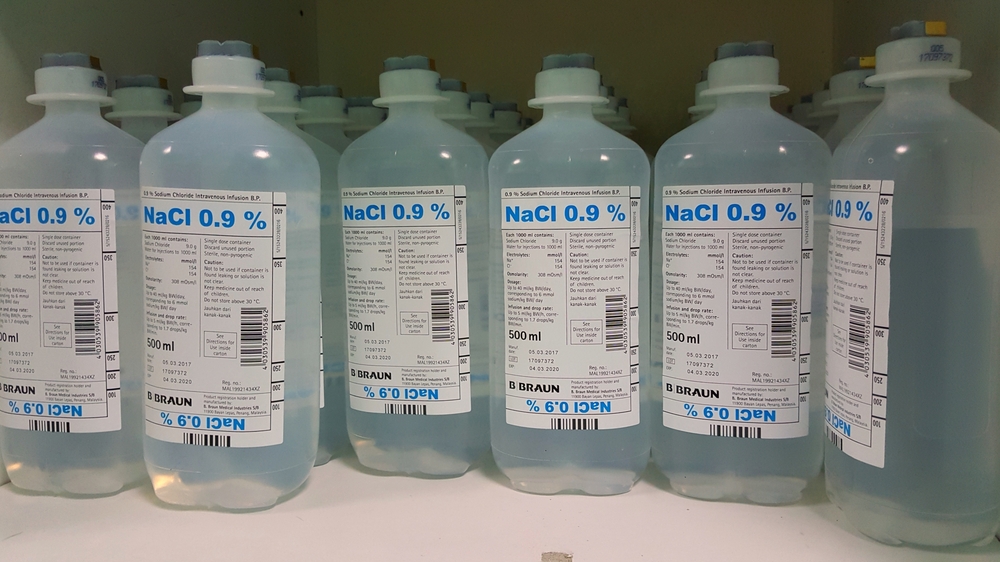
Less commonly, this solution is referred to as physiological saline or isotonic salineNormal saline is the chemical name for salt. The generic name is sodium chloride. It is a sterile, nonpyrogenic crystalloid fluid administered via an intravenous solution. Normal saline infusion is used for extracellular fluid replacement (e.g., dehydration, hypovolemia, hemorrhage, sepsis), treatment of metabolic alkalosis in the presence of fluid loss, and for mild sodium depletion. Normal saline can aslo be used as a flush -- to clean out an intravenous (IV) catheter. This helps prevent blockage and removes any medicine left in the catheter area after the patient has received an IV infusion. Dosage is dependent upon the age, weight and clinical condition of the patient as well as laboratory determinations. Normal saline solution can be administered only via intravenous (IV) access.
0.9% Normal Saline (NS, 0.9NaCl, or NSS) is one of the most common IV fluids, it is administered for most hydration needs: hemorrhage, vomiting, diarrhea, hemorrhage, drainage from GI suction, metabolic acidosis, or shock. It is an isotonic crystalloid that contains 0.9% sodium chloride (salt) that is dissolved in sterile water. It’s the fluid of choice for resuscitation efforts as well. It is sometimes used with caution or even avoided in patients with cardiac or renal compromise because of the sodium causing fluid retention or volume overload. IMPORTANT: NS is also the only fluid used in conjunction with blood product administration.
- 2
Lactated Ringers (LR, Ringers Lactate, or RL)
The IV solution most similar to blood plasma concentration, it is the fluid of choice for burn and trauma patients. It used for acute blood loss; hypovolemia from third-space fluid shifts; electrolyte imbalance; and metabolic acidosis. LR is an isotonic crystalloid containing sodium chloride, potassium chloride, calcium chloride, and sodium lactate in sterile water. It is contraindicated in patients with a pH > 7.5, patients with liver disease who are unable to metabolize lactate, or for any patient with lactic acidosis. Use with extreme caution in cases of renal failure.
Watch the following video if you want to learn more about administering Lactated Ringers.
- 3
Dextrose 5% in Water (D5 or D5W, an intravenous sugar solution)
A crystalloid that is both isotonic and hypotonic, administered for hypernatremia and to provide free water for the kidneys. Initially hypotonic, D5 dilutes the osmolarity of the extracellular fluid. Once the cells have absorbed the dextrose, the remaining water and electrolytes become an isotonic solution. D5 should not be used as the sole treatment of fluid volume deficit, because it dilutes plasma electrolyte concentrations. It is contraindicated in resuscitation, early post-op recovery, cardiac and renal conditions, and in any case of suspected increased intracranial pressure. Because the solution contains calories, due to dextrose (a form of glucose) as the solute, it does provide very limited nutrition.
Here is a short animation that explains consequences of fluid overload for tissues.
- 4
0.45% Normal Saline (Half Normal Saline, 0.45NaCl, .45NS)
A hypotonic crystalloid solution of sodium chloride dissolved in sterile water, administered to treat hypernatremia or diabetic ketoacidosis.. It is contraindicated in patients with burns, trauma, or liver disease due to depletion of intravascular fluid volumes. Half normal saline may result in fluid overload and subsequent decreased electrolyte concentrations or pulmonary edema. Infusing too quickly can cause hemolysis of red blood cells.
Colloids: Less frequent, but important!
Colloids have large molecules that are unable to pass through semipermeable membranes. They remain in the blood vessels. They’re also called volume or plasma expanders, because they draw fluid from the interstitial space back into the blood vessels with oncotic pressure. Because colloids require less volume than crystalloid solutions, they are used for patients who are unable to tolerate large fluid volumes, or are malnourished.
Some of the uses for colloids are shock, external burns, pancreatitis, peritonitis, and post-op albumin loss. Common colloids are Albumin and Hespan.
As a nurse, learn the types of IV solutions, and the reasons they are administered. Be aware of contraindications, and notify the prescribing provider if you know any reasons the patient should not receive fluid replacement with the solution.
More help for you

Pass Your NCLEX
Preparing for your NCLEX RN or PN? Sure you can study the dusty textbooks, but they don’t give you a pass guarantee. We do. Pass using our fast and efficient method, or your Premium membership is free.
Discover Premium91% of people found this article helpful.
Click a star to add your vote
87 votes - average 4.53 out of 5
91% of people told us that this article helped them.