Premium Login
How to Choose a Homecare Agency: the Inside Scoop


From Nurse Ingrid’s Notebook
“In all my years running a homecare agency, I can perhaps count less than a dozen times when the person doing the shopping actually came around to investigate us in person. That is to say that for the most part, choosing and hiring a homecare agency happens over the phone. Narrow down your search to two or three agencies that are local to you, and follow my guidelines for a more confident approach”, says Nurse Ingrid, the Nurse Plus Academy medical advisor.
What the agencies will all say
They will all claim to have the most thorough screening procedures for the caregivers on their rosters, including reference and criminal background checks. They will also say things such as they are licensed, insured, and the like. Don’t be too impressed with that since:
- You will want to examine those processes in greater detail
- For the most part, it is a licensing requirement in all states that they do all that; in other words, they have to, by law.
“They will also say things such as they are licensed, insured, and the like. Don’t be too impressed with that.”
My four guidelines to see you through to a happy experience:
1. Criminal Background checks
There are different types of criminal background checks:
- You can run a police check on someone for misdemeanors and felonies over the past five years in the state where they currently reside
- You can run the same check over ten years in all the states where they resided
- You can run an FBI check for the entire country and for an infinite duration
Ask the agencies you speak to about their policy in that regard. You might naturally want to give extra credit to the agency that pays a little more to obtain the more thorough background checks.
2. Reference checking
Although in most states one reference check is sufficient, many agencies will run two reference checks from people, other than family, who hired each caregiver in the past. The caregiver’s file thus has to display that fact, together with the initials or signature of the person who did the checking.
If you want to be truly inquisitive -- and more than a little assertive -- you will ask whoever you are talking to in regard to the specific staff person who does the checking. The point is this: for your mom’s caregiver, you will want that person to be above an admin assistant’s pay grade. Nothing against admin assistants, but getting references is an art, and you may want to make sure that it is at least a care coordinator or supervisor who routinely performs that task.
3. Interviewing the caregiver selected for you
Although most agencies offer that service for free, it is my experience that many people go by the agency’s phone description of the caregiver chosen for them, rather than interviewing the caregiver.
Here are my views:
- Always ask to interview the caregiver, and schedule it at your loved one’s home
- In fact, ask to interview two caregivers at separate times
- Always insist that the caregiver arrive for the interview unaccompanied, i.e. without another person from the agency

Face-to face meeting can give you much more information and food for thought than a phone conversationOne of the key issues you want to ascertain from the interview is the caregiver’s loyalty and good feelings towards her agency. This speaks volumes as to the agency’s culture, and you will be astounded at the number of caregivers who will badmouth their employers, a sure sign to stay away from that agency.
Besides, this gives you the added advantage of choosing between two of their presumed best caregivers for Mom, not to mention the enormous benefit of seeing how Mom reacts to each one of the interviewees.
4. The weekend fill-in caregivers
If agencies have one Achilles Heels, it would have to be this one: the caregivers they resort to for filling-in for primary caregivers on weekends and holidays, or when the primary caregivers call-out sick.

A new face may be a pleasant surprise if a standby caregiver is reliableGenerally speaking, this affects care recipients who need continuous care, seven days a week. If your loved one is not in that category, you don’t have much to worry about, although it nevertheless reflects on the intuitiveness of the agencies you are talking to.
Agencies depend on standby caregivers to fill-in for regular, 5 days a week workers. Can you already sense the problem? Why are standby caregivers not working full-time? Are they any less worthy than the rest of the fully-occupied aides? The answer is: not necessarily, although this bears looking into.
Agencies will rightly tell you that they always have caregivers on standby for emergencies and weekend duties, but trust me, these best laid plans have a tendency to come out flat on occasion, and the smaller the agency, the more this potential pitfall.
If Mom needs services 7 days a week, chances are the agency will try, and frequently fail, to send the same fill-in caregiver for the weekends. Mom will likely thus end up with an assortment of different caregivers as times goes by -- not a happy outcome.
“Mom will likely thus end up with an assortment of different caregivers as times goes by -- not a happy outcome.”
This is not ideal for these obvious reasons:
- Every time someone new shows up, they have to “hit it off” with Mom and be oriented on what needs to be done
- By virtue of the fact that Mom needs services 7 days a week, she probably has difficult conditions to deal with, including perhaps frequent transfers, incontinence, or Mom may herself be a difficult person to deal with, which drastically complicates matters
- Finally, fill-in personnel don’t have the same motivation to do well as primary or full-time caregivers; they may frequently arrive at Mom’s home with the wrong mindset
- It is often the case that these fill-in caregivers are spoken to at the last minute when the scheduled weekender calls out sick; the agency may thus be at a loss as to whom to send, and thereby not too selective
In short, weekend fill-in caregivers constitute the agency’s worst weakness, invariably causing agencies to mess up and send to Mom just anyone who happens to be available, irrespective of how good a match she is with Mom’s requirements.
You would thus do well to inquire into how the agency you’re talking to manages these weekend emergencies. What do they do when they can’t find anyone appropriate to send to Mom?
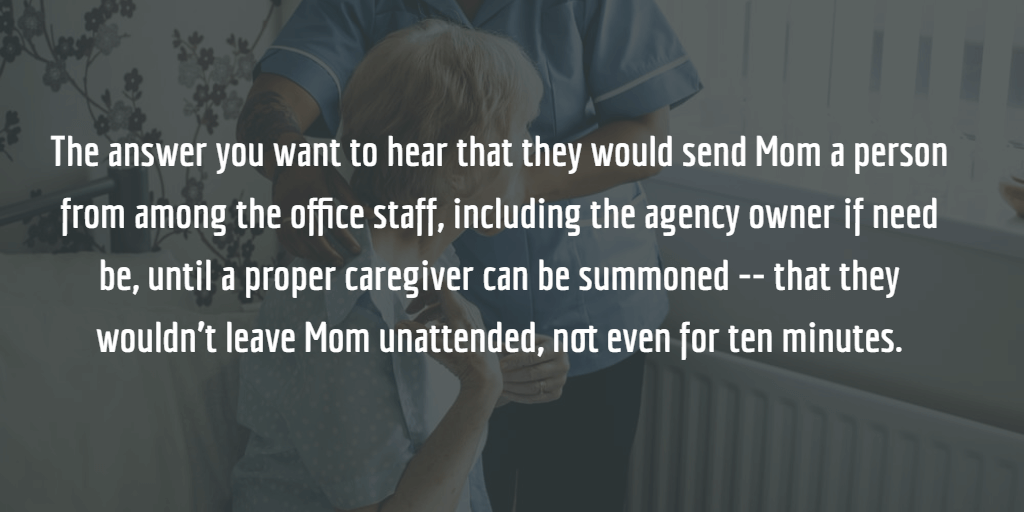
This is exactly what you want to hear from the agency
Final thoughts
You’re now equipped with the inside scoop on how to choose a homecare agency. Let me just part with this thought. The agencies you talk to are all well intentioned. They wouldn’t be in that trade if they’re not that way disposed. It’s just that they often chew more than they can swallow, taking on more new clients than they have caregivers for, hoping to somehow be able to match them up properly.
Trust me though, despite all the laser-sharp questions you now have at your disposal, chances are you will in the end finalize with the agency person who inspires you the most as being genuine and truthful. That is how this business of ours works.
More help for you

Pass Your NCLEX
Preparing for your NCLEX RN or PN? Sure you can study the dusty textbooks, but they don’t give you a pass guarantee. We do. Pass using our fast and efficient method, or your Premium membership is free.
Discover Premium100% of people found this article helpful.
Click a star to add your vote
2 votes - average 5 out of 5
100% of people told us that this article helped them.