Premium Login
Patient Satisfaction: 3 Key Strategies for Getting the Highest Score


The healthcare market has undergone countless changes over the past ten years. Some examples:
- The Affordable Health Care Act of 2010 (ACA) caused a shift from specialty care to primary care.
- Technology made electronic charting, patient monitoring, and use of data more available and efficient.
- Telemedicine allowed patients to get care without actually visiting a doctor.
- An increase of for-profit healthcare companies, meaning a more cost-focused approach to medicine.
- Health systems invested more in non-acute care settings, such as ambulatory surgical centers and physician practices.
For nurses, a major change from the ACA was the relationship of patient satisfaction ratings to the amount of reimbursement from the Centers for Medicare and Medicaid (CMS) for services provided. Measuring delivery of patient-centered care became a critical metric for CMS.
You’re reading one of our “Nursing Career Guide” articles. Need to practice for your upcoming exam? Take our free NCLEX practice test -- no registration required! ✨
The ACA included a program called Value-Based Purchasing and Hospital Consumer Assessment of Healthcare Providers and Systems (HCAHPS, pronounced “H-caps”). Originally used on a voluntary basis in 2006, The HCAHPS Survey was designed to evaluate a patient’s experience during their hospitalization.
The HCAHPS survey has 29 questions in nine key areas. Nursing care directly impacts seven of these. The survey is sent randomly to patients after they are discharged. The patients are asked to choose one of the following responses for each question: Always, Usually, Sometimes, or Never.
Here are the survey questions that relate to direct and indirect nursing care:
Your Care from Nurses
- During this hospital stay, how often did nurses treat you with courtesy and respect?
- During this hospital stay, how often did nurses listen carefully to you?
- During this hospital stay, how often did nurses explain thingsin a way you could understand?
- During this hospital stay, after you pressed the call button, how often did you get help as soon as you wanted it?
The Hospital Environment
- During this hospital stay, how often were your room and bathroom kept clean?
- During this hospital stay, how often was the area around your room quiet at night?
Your Experiences in This Hospital
- During this hospital stay, did you need help from nurses or other hospital staff in getting to the bathroom or in using a bedpan?
- How often did you get help in getting to the bathroom or in using a bedpan as soon as you wanted?
- During this hospital stay, did you need medicine for pain?
- During this hospital stay, how often was your pain well controlled?
- During this hospital stay, how often did the hospital staff do everything they could to help you with your pain?
- During this hospital stay, were you given any medicine that you had not taken before?
- Before giving you any new medicine, how often did hospital staff tell you what the medicine was for?
- Before giving you any new medicine, how often did hospital staff describe possible side effects in a way you could understand?
When You Left the Hospital
- During this hospital stay, did doctors, nurses or other hospital staff talk with you about whether you would have the help you needed when you left the hospital?
- During this hospital stay, did you get information in writing about what symptoms or health problems to look out for after you left the hospital?
Overall Rating of the Hospital
- Using any number from 0 to 10, where 0 is the worst hospital possible and 10 is the best hospital possible, what number would you use to rate this hospital during your stay?
- Would you recommend this hospital to your friends and family?
Consumers can find scores for any hospital by visiting Hospital Compare. Hospitals are rated by a star system, allowing potential patients to compare performances for conditions such as heart attack, heart failure, pneumonia, and surgery. Each hospital’s report shows how it ranks in comparison to the state and national averages.
Results are organized by:
- General information
- Patient experience survey
- Timely and effective care
- Complications
- Readmissions and deaths
- Use of medical imaging
- Payment and value of care
With patient satisfaction being crucial to how much CMS reimburses the hospital, nurses are the key to success. Here are three areas that you can influence, starting with your next shift:
- 1
Communicate clearly and often!
Be proactive in keeping your patients informed. Use the “white board” to provide staff names, tests, activities, and other information for the shift. Check in with your patients frequently to keep them updated about their care and their progress. Be sure to communicate in a way the patient and family members can understand. Allow time for them to ask questions and take notes.
Remember that listening is an important part of communication. Encourage them to share concerns with the staff. Pay attention to non-verbal signals: tone-of-voice, gestures, and facial expressions. Give them your full attention by looking them in the eyes and using proper posture.
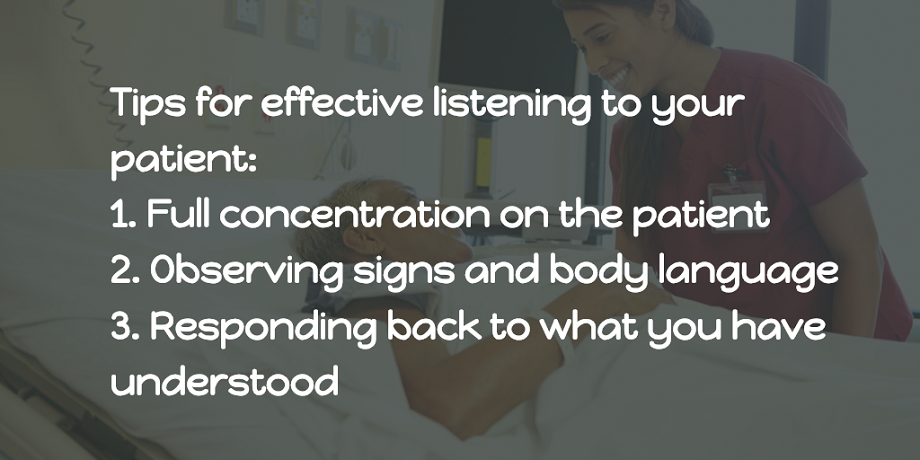
Active listening is an indispensable part of communication - 2
Educate, educate, educate!
There are many opportunities to educate your patients and involve them in their care. Ask them what they know about their condition and fill in their knowledge gaps. Use the “teach-back” method when administering medications. Don’t wait for them to ask questions, or assume that because they don’t ask, they understand what is going on. Educate them on laboratory tests, procedures, or their diet.
Remember that “discharge begins on admission.” HCAHPS likes to focus on how prepared a patient is to care for themselves at home. Be sure to go over areas such as medication side effects and contraindications, as these are specific questions always asked on the survey.

Ineffective discharge process can easily spoil the impression from the hospital stay - 3
Be cognizant of noise level and cleanliness.
Hospitals are noisy. Carts, gurneys, wheelchairs are constantly transporting patients. Staff stop to talk to one another. Nights are not always quiet. Rooms get cluttered. Gloves and masks can quickly overfill a waste can.
Although the staff becomes accustomed to the events on a unit, patients can become more anxious if they feel they aren’t in a quiet and clean place. One of the most frequent patient complaints related to the hospital environment are that the noise level exceeded what they deemed appropriate and their rooms were not always clean.
Nurses can lead the way by monitoring the noise volumes and reminding others to speak quietly. Report squeaky transport equipment, and let patients know if there is going to be a lot of “traffic” in the halls.
To maintain a high level of cleanliness, practice good hand hygiene in front of the patients. Clear up packaging or extra equipment as soon as possible. Empty waste cans when they get full. Don’t let dietary trays stay in patients’ rooms for extended times.
Here are some more ideas how to reduce noise level in the hospital:
When HCAHPS survey scores are high, the hospital receives better reimbursement. Watch this short video to get a review of the major areas for improvement:
Receiving the maximum reimbursement enables a healthcare organization to continue to grow and expand; provide more funds for wage increases; and keep improving equipment and facilities. Nurses take pride in always giving patient-centered care. When you focus on the patient’s experience, you’re already on the way to earning the highest ratings. After all, you simply want to treat your patients as you would want to be cared for.
More help for you

Pass Your NCLEX
Preparing for your NCLEX RN or PN? Sure you can study the dusty textbooks, but they don’t give you a pass guarantee. We do. Pass using our fast and efficient method, or your Premium membership is free.
Discover Premium100% of people found this article helpful.
Click a star to add your vote
3 votes - average 5 out of 5
100% of people told us that this article helped them.