Premium Login


“Will I pass my NCLEX?” “Do the Next Generation (NGN) test items make it more difficult?”
“What are the pass rates since NCLEX added the ongoing case studies?”
Nurse Plus receives queries like these all the time. Passing the National Council Licensure Examination (NCLEX) is the final—and necessary--step in obtaining a professional license for nursing graduates in the United States, Canada, and Australia. NCLEX validates the new nurse’s knowledge, skills, and abilities related to increasingly complex patient care. It also determines minimal competency in clinical judgment.
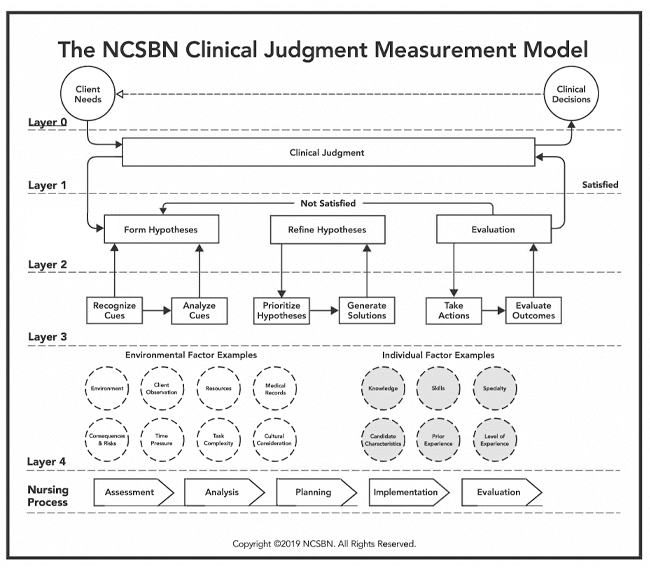
On April 1, 2023, the National Council of State Boards of Nursing (NCSBN)—the organization that creates and oversees the standardized test—updated the format to include different metrics that can more accurately evaluate an entry-level nurse’s ability to implement proper clinical judgment to provide safe care to patients. Three case studies (6 questions each) and new test item formats were added as assessment tools, based on the NCSBN Clinical Judgment Measurement Model (NCJMM).
Clinical judgment is defined as “the observed outcome of critical thinking and decision making. It is an iterative process that uses nursing knowledge to observe and assess presenting situations, identify a prioritized client concern, and generate the best possible evidence-based solutions in order to deliver safe client care.” (NCSBN)
The NCJMM includes six Clinical Judgment skills that nurses use when caring for their patients. Presented in three “ongoing” (or “unfolding” or “evolving”) case studies, candidates are evaluated on their ability to anticipate and provide appropriate actions, using data to provide safe care and prevent unnecessary complications:
- Recognize cues: “What matters most?”
- Analyze cues: “What does it mean?”
- Prioritize hypotheses: “Where do I start?”
- Generate solutions: “What can I do?”
- Take action: “What will I do?”
- Evaluate outcomes: “Did it help?”
Pass Rates: Before and After NGN
Candidates were naturally concerned about the NGN. It seemed more challenging, as well as more complex for the timed examination. The total number of test items increased from 85 to 150, just a few more than the previous 75-145. (Including 15 questions that are being evaluated for future examinations, the same as before the NGN.)
What happened? With the inclusion of Next Generation test items, pass rates INCREASED! Regardless of how the candidates received their education and training, they were more successful at passing on their first attempt.
The NGN also changed its scoring method. Each test item used to be all-or-none (+/-), but the NGN allows for partial credit for some test items, such as the select-all-that-apply (SATA).
Nursing school curriculums were modified to include critical judgment skills, a huge step beyond traditional nursing education. The conclusion: Entry-level nurses are better prepared to care for their patients in an ever-changing medical system.
2023 NCLEX Pass Rates: First Year with NGN
RN 1st time, U.S educated | Number taking NCLEX | Yearly Pass Rate |
| Diploma | 2,184 | 89.10% |
| BSN Degree | 90,330 | 90.17% |
| Associate Degree | 83,387 | 87.75% |
| RN, 1st time, international | 21,978 | 52.60% |
PN 1st time, U.S. Educated | 12,844 | 91.09% |
| PN, 1st time, International | 137 | 54.03% |
2022 NCLEX Pass Rates: Most Recent Year before NGN
RN 1st time, U.S educated | Number taking NCLEX | Yearly Pass Rate |
| Diploma | 2,195 | 78.31% |
| BSN Degree | 98,942 | 82.32% |
| Associate Degree | 85,750 | 77.91% |
| RN, 1st time, international | 35,074 | 43.18% |
PN 1st time, U.S. Educated | 11,213 | 79.93% |
| PN, 1st time, International | 111 | 50.49% |
2021 NCLEX Pass Rates: Two Years Before NGN
RN 1st time, U.S educated | Number taking NCLEX | Yearly Pass Rate |
| Diploma | 2,296 | 79.63% |
| BSN Degree | 94,308 | 86.06% |
| Associate Degree | 88,349 | 78.78% |
| RN, 1st time, international | 18,495 | 46.48% |
PN 1st time, U.S. Educated | 46,356 | 79.60% |
| PN, 1st time, International | 435 | 51.49% |
Want to view NCLEX pass rates from 1983 to the most recent quarter? Click here.
Why did NCLEX change?
Pass rates before implementation of NGN seem satisfactory, so why did NCSBN change the examination? Simple: Every three years, NCSBN does a comprehensive survey and review of current nursing practice. As early as 2009, NCSBN began to consider how to measure clinical judgment on NCLEX.
How nurses practice is constantly evolving, so NCLEX always reflects the changes. In analyzing current practice, the Section Research Section discovered:
- Clinical judgment is directly linked to more than 46% of tasks performed by entry-level nurses.
- Problem-solving and critical thinking are required for more than 30% of tasks performed by entry-level nurses.
However, NCLEX wasn’t effectively evaluating clinical judgment. The Special Research Section found:
- 50% of medical errors involve new nurses
- 65% of errors are related to poor clinical decision-making
- Only 20% of employers are satisfied with clinical judgment of new nurses
- A separate study by Johns Hopkins Medicine found that medical errors are one of the leading causes of death in the United States, along with heart disease and cancer
How to prepare for Next Generation NCLEX
The good news: Nursing education now incorporates critical judgment. Although students will always continue to learn about traditional topics such as disease processes, lab values, and medication calculations, nursing schools guide students to apply critical judgment when approaching those same topics.
- Learn more about the examination process. Download and read the NCLEX Candidate Bulletin and Information Flyer to obtain start-to-finish information on everything from registering for the exam, to how the exam is scored, to receiving results.
- Get the NCLEX Test Plan. Both RN and PN candidates should download and review their respective Test Plan to learn about exam content. Test Plans reflect how test items are written and distributed according to Client Needs categories/subcategories. Test plans are in effect until March 31, 2026.
The Test Plans also help when studying for the examination. Some categories or subcategories have a greater percentage of test items, so candidates can focus accordingly during preparation.
| NCLEX-RN Test Plan | NCLEX-PN Test Plan | ||
| Client Needs | % from Category or Subcategory | Client Needs | % from Category or Subcategory |
| Safe & Effective Care Environment | Safe & Effective Care Environment | ||
| Management of Care | 15-21% | Coordinated Care | 18-24% |
| Safety & Infection Control | 10-16% | Safety & Infection Control | 10-16% |
| Health Promotion & Maintenance | 6-12% | Health Promotion & Maintenance | 6-12% |
| Psychosocial Integrity | Psychosocial Integrity | ||
| Basic Care & Comfort | 6-12% | Basic Care & Comfort | 7-13% |
| Pharmacological & Parenteral Therapies | 13-19% | Pharmacological & Parenteral Therapies | 10-16% |
| Reduction of Risk Potential | 9-15% | Reduction of Risk Potential | 9-15% |
| Physiological Adaption | 11-17% | Physiological Adaption | 7-13% |
- Check out the NCSBN Candidate Tutorial. Read explanations of the new test items and practice with non-medical questions. Nurse Plus also provides details and examples of the new formats—click here to read the article.
- Develop a study plan that works for your learning style and your schedule. Don’t wait until a week or two before your exam appointment to try and cram years of education into your brain. Use these tips and tricks from successful candidates.
- Practice, practice, practice! Take as many practice tests as possible before sitting for the examination. Read every test item carefully. Retake tests and test items that were incorrect.
Reasons to spend time each day preparing include:- Reviewing nursing education topics
- Listing—and researching—topics that require further study
- Becoming familiar with the NCLEX test item formats
- Increasing recognition of relevant cues presented in test items
- Gaining confidence in ability to use critical judgment
- Reducing stress on examination day
What’s the takeaway lesson from pass rates?
NGN-NCLEX candidates who are serious nursing students—and have sound study habits—do well on their examinations. Making the most of both classroom and clinical opportunities provides a solid foundation that extends into licensure and career. And remember that most candidates will pass on their first attempt.
Still have questions about the NGN? Click here for FAQs.
More help for you

Pass Your NCLEX
Preparing for your NCLEX RN or PN? Sure you can study the dusty textbooks, but they don’t give you a pass guarantee. We do. Pass using our fast and efficient method, or your Premium membership is free.
Discover PremiumBe the first to rate this article!
Click a star to add your vote
0 votes - average 0 out of 5
Be the first to rate this article!